Tower of Gand Review — A Deep Dive Into This Dungeon-Crawling RPG
Tower of Gand is a permadeath dungeon-crawling RPG developed by Toihaus and published by Asobuild that blends classic turn-based combat with roguelike unpredictability. With its 5×5 panel exploration system, over 40 unique classes, and a sanity mechanic that constantly threatens to push your character into madness, the game offers a tense and strategically demanding experience that rewards patience, planning, and a willingness to accept failure.
The Gameplay Loop — Exploration, Combat, and Consequence
At the heart of Tower of Gand lies its 5×5 grid-based dungeon exploration. Each floor presents a grid of hidden panels that you reveal one at a time, uncovering enemies, treasure, events, or the staircase needed to ascend. The system encourages deduction — experienced players learn to read the patterns and weigh the risk of each reveal against the potential reward. Since enemies, loot, and events are randomized on every run, no two attempts at the tower play out the same way, which keeps early floors feeling fresh even after dozens of failed attempts.
Combat is strictly turn-based and offers five distinct actions: Attack, Skill, Defend, Talk, and Escape. Each class handles these options differently, so understanding your assigned class's strengths is essential. The Talk and Escape options introduce a layer of decision-making that goes beyond raw damage output — sometimes negotiation or retreat is the smarter play, especially when your resources are low. Gold plays a dual role as both lifeline and liability; spending it wisely can save a run, while poor financial decisions hasten your demise.
Permadeath is the defining feature here. When your character dies, you lose everything — progress, equipment, gold. There is no safety net and no second chance. This design philosophy means every encounter carries genuine tension, and victories earned through careful strategy feel deeply satisfying. It is a punishing system, but one that gives each decision real weight.
Classes and Replayability
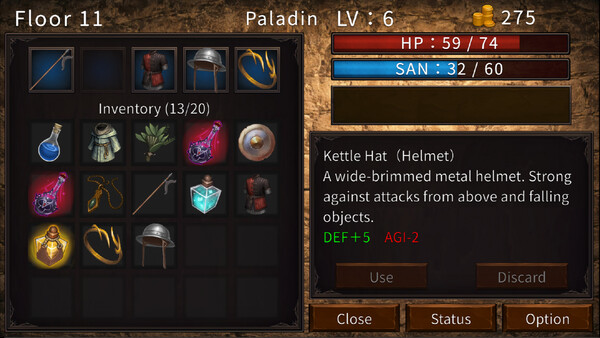
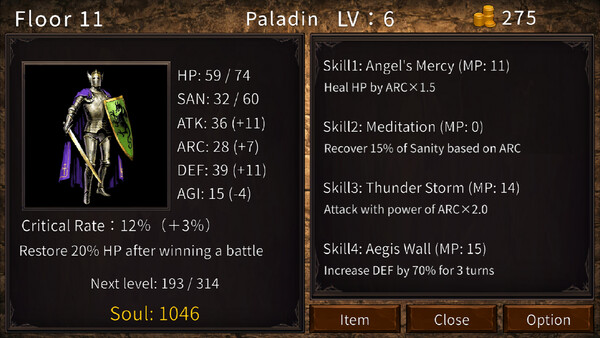
Tower of Gand features over 40 unique classes, and your class is randomly assigned at the start of each run. This single design choice has enormous implications for replayability. You cannot simply master one build and coast through the tower — every new attempt forces you to adapt to a different skill set, growth path, and tactical approach. A class that thrives in direct combat may struggle against the tower's sanity-draining events, while a class built around evasion or negotiation might crumble against certain boss encounters.
The random class assignment also solves one of the most common complaints in roguelikes: the tendency to settle into a comfort zone. By removing player choice at the outset, Tower of Gand ensures that each run is a genuine learning experience. Over time, you build familiarity with the full roster, and the game rewards that accumulated knowledge with deeper strategic options. The result is a game that remains compelling well beyond the point where many similar titles begin to feel repetitive.
That said, not every class feels equally viable. Some clearly have smoother paths through the early floors, while others demand near-perfect play just to survive the opening encounters. Whether this represents a balance issue or an intentional difficulty gradient is open to debate, but it is worth noting for players who have low tolerance for runs that feel doomed from the start.
The Sanity System — Tower of Gand's Signature Mechanic
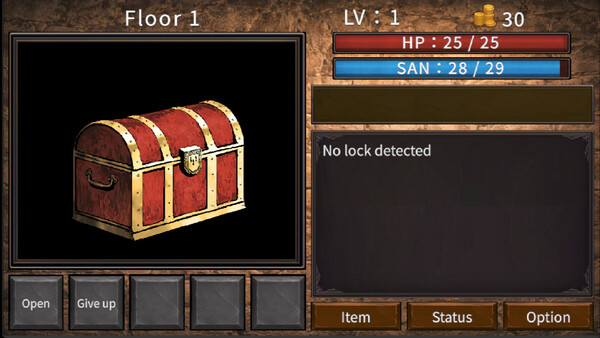
The sanity system is arguably Tower of Gand's most distinctive feature. Your character's sanity drains constantly while inside the tower, creating a persistent time pressure that prevents overly cautious play. If sanity reaches zero, your character descends into madness, which leads to inevitable death. Managing this resource adds a strategic dimension that elevates the game above many of its roguelike peers — you are never simply clearing rooms, you are always racing against your own deteriorating mental state.
Various events and encounters within the tower can accelerate or slow sanity loss, and learning which panels and situations tend to affect sanity becomes part of the metagame. The system forces players into difficult trade-offs: do you explore one more panel hoping for treasure that could fund your survival, or do you head for the staircase before madness claims you? These moment-to-moment decisions are where Tower of Gand shines brightest, delivering the kind of agonizing strategic choices that define great roguelikes.
Difficulty and Accessibility
Tower of Gand is uncompromisingly difficult. The permadeath system, random class assignment, and constant sanity drain combine to create a game where failure is not just possible but expected. Early runs will almost certainly end in death, and the game offers little in the way of tutorials or hand-holding. Players who enjoy learning through repeated failure — piecing together strategies from the wreckage of past attempts — will find a deeply rewarding experience here. Those who prefer steady, measurable progress may find the early hours frustrating.
On the accessibility front, Tower of Gand supports mouse-only play and does not require timed inputs, which makes it approachable from a mechanical standpoint even if the strategic difficulty remains high. The save-anytime feature is a welcome quality-of-life inclusion that respects the player's time without undermining the permadeath stakes. The game also supports a broad range of languages including English, Japanese, Chinese (Simplified and Traditional), Korean, and several European languages, broadening its potential audience considerably.
The lightweight system requirements — an Intel Core i3 processor, 4 GB of RAM, and just 200 MB of storage at minimum — mean that virtually any modern PC can run the game without issue. This low barrier to entry is a significant plus, especially for players who want to try the free demo before committing to a purchase.
Is Tower of Gand Worth Buying?
Tower of Gand occupies a well-defined niche: it is a game for players who appreciate classic roguelike design principles — true permadeath, randomized challenges, and deep tactical combat — delivered through a polished turn-based RPG framework. The 5×5 panel exploration system gives dungeon crawling a puzzle-like quality, the massive class roster guarantees variety across runs, and the sanity mechanic adds a layer of urgency that keeps every floor feeling dangerous. For fans of games that demand mastery through repetition and reward strategic thinking above all else, Tower of Gand is an easy recommendation.
At its current price point, with a free demo available to test the waters, the value proposition is strong. The game does not overstay its welcome on any single run, but the sheer number of classes and the randomized nature of each attempt ensure that the total playtime investment can be substantial for players who get hooked on the loop. If you enjoy roguelikes that treat death as a teacher rather than a punishment, Tower of Gand delivers exactly that experience with confidence and style.
Where it may lose some players is in the early difficulty curve and the lack of meta-progression between runs. There are no permanent unlocks or carry-over bonuses to soften repeated failures — when you die, you truly start from nothing. For players accustomed to the gentler roguelite model, this can feel harsh. But for those who embrace the challenge, Tower of Gand stands as one of the more compelling entries in the permadeath RPG space.